

Smart Hospital
Accelerate hospital flows, optimise resources and enhance the patient experience thanks to digital technologySmart Hospital
Accelerate hospital flows, optimise resources and enhance the patient experience thanks to digital technology
Faced with increasing patient flows, pressure on care teams and budget constraints, healthcare establishments need to reinvent themselves.
The Smart Hospital is emerging as a key lever for improving the quality of care, streamlining care paths and optimising the use of resources.
Equans Digital supports this transformation by integrating data, systems and infrastructures to improve hospital performance.
Thanks to a global approach combining OT, IT, hypervision and systems integration, we help hospitals gain in efficiency, resilience and patient experience.
Meeting the challenges of the Smart Hospital: performance, fluidity and resilience at the heart of healthcare facilities
Hospitals face unprecedented challenges in the face of operational pressure, complex workflows and growing demands for quality of care.
The ability to optimise patient pathways, make better use of resources and guarantee continuity of care is becoming a strategic lever for ensuring their performance and attractiveness.
Healthcare establishments are faced with an ever-increasing flow of patients, making the management of patient care increasingly complex. Between admission, care and discharge, each stage must be perfectly orchestrated to avoid bottlenecks.
The digitisation of patient pathways, combined with real-time monitoring tools and flow analysis, makes it possible to streamline movements, optimise resource allocation and significantly reduce treatment times.
The result: an improved patient experience and faster, more efficient care.
Staff shortages and work overload are taking a heavy toll on medical teams. The time spent on administrative and logistical tasks reduces the time available for care.
The integration of digital tools, the automation of processes and the traceability of equipment all help to simplify the day-to-day work of caregivers. By facilitating access to information and reducing low value-added tasks, teams gain in efficiency and quality of work.
The result: more time for the patient, greater team satisfaction and a more attractive establishment.
Hospitals have to reconcile excellence in care with cost control, without additional resources. Optimising resources is therefore becoming a major strategic challenge.
The centralisation of technical systems, predictive maintenance and energy management all help to reduce operating costs while improving overall performance. By exploiting data, it becomes possible to anticipate needs and avoid the extra costs associated with malfunctions or poor resource allocation.
A concrete lever for improving profitability while maintaining a high level of service quality.
Capacity management is at the heart of hospital performance. Lack of visibility on bed or equipment availability can lead to delays or even loss of care opportunities.
Thanks to real-time geolocation technologies (RTLS) and supervision platforms, facilities have a precise view of resource occupancy and availability. This accelerates bed rotation, optimises admissions and increases capacity without structural investment.
Better operational responsiveness and optimal use of existing infrastructures.
Hospitals have to operate continuously, 24/7, with extremely high requirements in terms of security and system availability.
The integration of technical infrastructures, IT/OT systems and biomedical equipment into a hypervision platform enables real-time supervision of the entire hospital environment. This approach ensures better anticipation of incidents, increased responsiveness and optimal service continuity.
An essential condition for guaranteeing patient safety and overall facility performance.
Our approach: a system integrator at the heart of the Smart Hospital
With the growing complexity of hospital environments, the multiplication of systems - IT, OT, biomedical, energy and safety - creates silos that hamper overall performance.
Meeting the challenges of the Smart Hospital requires a global approach, capable of orchestrating all these technologies to serve a common goal: continuity and quality of care.

Equans Digital is positioned as a benchmark system integrator, capable of designing, deploying and managing a unified hospital-wide architecture.
- Multi-system integration: IT, OT, biomedical equipment, technical infrastructures, energy and safety
- Data interoperability: structuring and harmonizing information flows
- Unified target architecture: a global, coherent vision of all systems
An approach that breaks down technological silos and streamlines all hospital operations.
At the heart of our approach, the implementation of a single hypervision platform enables us to supervise and control all hospital activities.
- Centralization of data from all systems
- Real-time monitoring of patient flows, equipment and infrastructure
- Alert management and incident anticipation
Teams have a complete and instantaneous overview to make informed decisions and improve operational responsiveness.
By bringing together data from different environments - energy, HVAC, safety, BMS, biomedical, IT - Equans Digital helps build an intelligent, resilient hospital ecosystem.
- Continuous supervision of critical infrastructures
- Optimised availability of equipment and resources
- Improving the overall performance of the patient pathway
Data becomes a strategic lever for guaranteeing continuity of care, 24/7, and reinforcing the resilience of facilities.
Our ambition: a Smart Hospital focused on usage
The Smart Hospital is not just about technology. It is, above all, based on its ability to improve the day-to-day lives of patients, caregivers and management teams.
At Equans Digital, we place usage at the heart of our approach to designing hospitals that are smoother, more efficient and more humane.
Medical staff: simplifying daily life and giving time back to care
We help medical teams focus on what's most important: the patient.
- Simplify tasks: automate logistics and administrative operations
- Rapid access to information: patient and equipment data available in real time
- Better working conditions: reduced mental workload and unnecessary travel
A more efficient, stress-free working environment, favoring team efficiency and commitment
Patients: a smooth, personalised and reassuring experience
We're rethinking the patient journey to make it simpler, more transparent and more comfortable.
- End-to-end digitalisation: from pre-admission to discharge
- Real-time information: tracking steps and reducing uncertainty
- Personalised experience: connected services, in-room comfort, easier communication
Optimised, more human and more engaging care throughout the hospital stay.
Management: driving performance and aiming for operational excellence
We give hospital managers the means to manage their facilities with precision.
- Process optimisation: better coordination of flows and resources
- Budget control: data-driven cost management
- Continuous improvement: KPI tracking and informed decision-making
A global and strategic vision to sustainably improve care quality and facility performance.
Smart Hospital: tangible gains to improve the overall performance of healthcare facilities
The transformation to a Smart Hospital generates measurable benefits at all levels of the facility, by combining digitalisation of patient care, data-driven management and systems integration.

- Smoother patient pathways: reduced waiting times thanks to real-time flow management and improved coordination between departments, for faster, more efficient care.
- Optimised availability of beds and equipment: improved capacity management through geolocation and continuous monitoring, enabling more patients to be cared for with constant resources.
- Enhanced operational performance: real-time management of hospital activities, with a consolidated view of data to improve decision-making and overall efficiency.
- Enhanced patient experience: personalised, digitised patient pathway, from pre-admission to discharge, offering greater transparency, comfort and commitment throughout the stay.
- Time savings for care teams: reduced administrative and logistical tasks thanks to automation and simplified access to information, enabling teams to refocus on care.
- Attracting and retaining staff: improved working conditions and reduced mental workload, helping to boost team commitment and reduce staff turnover.
- Controlling operating costs: optimising expenditure through predictive maintenance, energy management and better resource allocation.
- Enhanced safety and quality of care: improved traceability of patients and equipment, fewer errors and more accurate diagnoses.
- Resilience of hospital infrastructures: continuous supervision of critical systems and anticipation of incidents to guarantee 24/7 service continuity.
Explore our expertise to make your Smart Hospital a reality
From digitising patient pathways to systems integration, Equans Digital mobilises all its expertise to support the transformation of healthcare establishments.
Find out how our solutions can meet your performance, resilience and patient experience challenges.





Our references: from concept to reality in the Smart Hospital
Through concrete projects, Equans Digital supports healthcare establishments in implementing the Smart Hospital, combining systems integration, automation and data-driven management, with the aim of transforming hospitals into connected, high-performance environments.
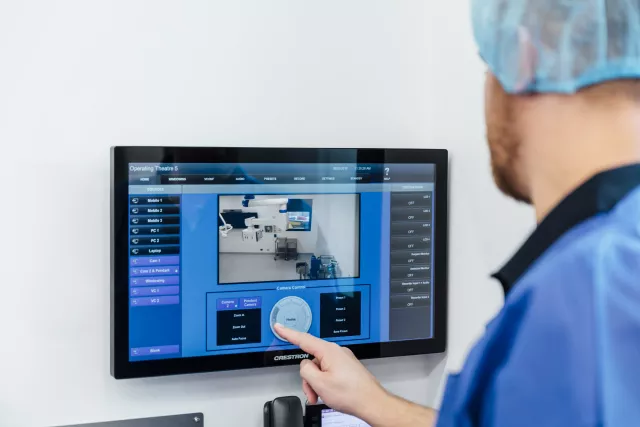
A trusted partner for hospitals worldwide

Offer your patients and staff a new hospital experience
Improve the quality of care, make daily life easier for caregivers and optimize the use of your resources. Equans Digital can help you design a more fluid, more human and more efficient hospital, where technology becomes an ally in the service of care. Let's talk about your Smart Hospital challenges.Offer your patients and staff a new hospital experience
Improve the quality of care, make daily life easier for caregivers and optimize the use of your resources. Equans Digital can help you design a more fluid, more human and more efficient hospital, where technology becomes an ally in the service of care. Let's talk about your Smart Hospital challenges.