

Caen University Hospital: Automating Technical Systems Through Building Automation
Caen University Hospital: Automating Technical Systems Through Building Automation

How Equans Digital Led the Automation of the HVAC and Plumbing Systems at the New Caen Normandy University Hospital
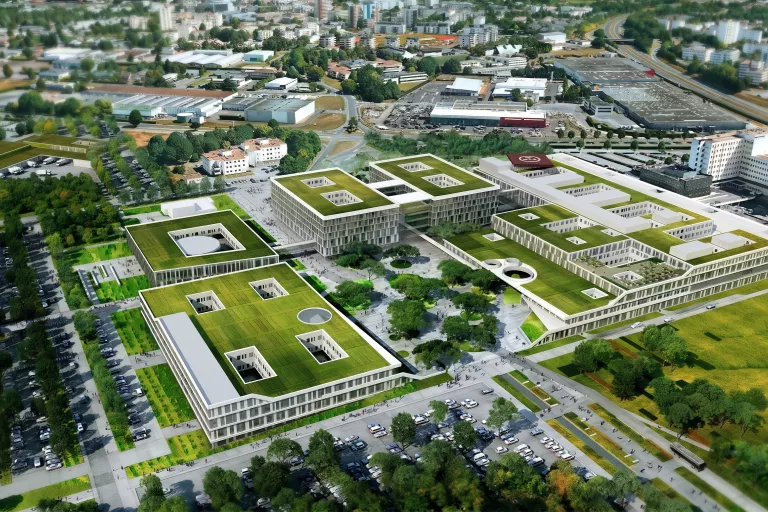
The construction of the new Caen Normandy University Hospital (CHU) marks a major milestone for healthcare services in the Normandy region. With its 110,000 m², 1,397 beds, 35 operating rooms, and 26 medical imaging rooms, this next-generation facility was designed to address current and future healthcare challenges.
To ensure the performance, reliability, and continuous operation of critical technical systems, the Equans Digital Building Automation teams implemented all automation and control systems for the HVAC (Heating, Ventilation, Air Conditioning) and Plumbing systems, helping to make the future University Hospital a smart, high-performance, and sustainable hospital building.
Caen University Hospital: A New Hospital to Meet the Healthcare Challenges of Tomorrow
The Caen Normandy University Hospital has launched a major reconstruction project to replace infrastructure that has gradually become unsuitable for the modern demands of the hospital sector.
The historic hospital, which opened in the 1970s, was no longer able to effectively meet the demands of new healthcare models; evolving medical practices; increasing regulatory requirements; and the comfort needs of patients and healthcare staff.
The project for the new facility thus aims to improve the patient care pathway; consolidate services to minimise travel; expand outpatient care; integrate state-of-the-art medical equipment; provide more private rooms; and ensure better energy efficiency for the building.
The project’s challenges: designing a hospital infrastructure capable of meeting the demands of modern medicine
The construction of the new Caen Normandy University Hospital was not limited to replacing aging buildings. The goal was to design a next-generation hospital capable of keeping pace with evolving medical practices, improving the patient experience, and ensuring optimal operating conditions for healthcare teams.
In this context, the technical infrastructure presented a major challenge. The heating, ventilation, air conditioning, and plumbing systems had to ensure flawless operating conditions at all times, both for patients and for sensitive medical equipment. To meet these objectives, several strategic challenges had to be addressed.
Opened in the 1970s, the old hospital had been designed with a vertical, compartmentalised layout that no longer met today’s hospital standards.
Architectural constraints, regulatory changes, fire safety issues, and the presence of asbestos made the renovation work particularly complex. Given these limitations, building a new facility was the most appropriate solution to support the university hospital’s long-term growth.
The challenge, therefore, was to design a modern, scalable technical infrastructure capable of meeting the needs of the coming decades.
In a facility with 35 operating rooms and 26 medical imaging rooms, precise control of technical parameters is absolutely essential.
Temperature, air quality, differential pressure, air exchange rates, and humidity must be controlled with extreme precision to ensure patient safety, the comfort of medical staff, and the proper functioning of medical equipment.
Automating the technical systems was therefore intended to maintain consistent and reliable performance throughout the facility, including in the most sensitive areas.
The new university hospital was designed to accommodate new medical practices and the increase in outpatient care.
The consolidation of departments, the expansion of private rooms, and the creation of more comfortable spaces were intended to streamline the care pathway while improving the experience for patients and their loved ones.
To achieve this goal, the technical systems were required to ensure a high level of thermal comfort, air quality, and equipment availability throughout the building.
A hospital cannot tolerate any service interruptions in its critical infrastructure.
Heating, ventilation, air conditioning, and plumbing systems—as well as the IT equipment housed in the data center—must operate continuously to ensure the quality of care and the safety of occupants.
One of the project’s main challenges was therefore to deploy a robust automation architecture capable of providing continuous monitoring of equipment and reliable control of technical systems.
Given the size of the future facility, the various technical systems needed to be able to communicate within a unified ecosystem.
The decision to adopt an architecture based on open standards was intended to facilitate the building’s future operation, ensure compatibility among the various systems, and prepare for future technological advancements.
This approach was a key factor in making the new Caen University Hospital a truly connected hospital, capable of sustainably integrating innovations in Smart Building and Building Automation.
Why choose Equans Digital for your hospital building automation projects?
Healthcare facilities require complete control over technical systems, which directly impact patient safety, occupant comfort, and the availability of medical equipment.
Thanks to its expertise in Building Automation,BMS, Smart Building, industrial automation, HVAC control, and critical infrastructure management, Equans Digital supports healthcare providers in the design, deployment, and operation of hospital buildings that are increasingly efficient, resilient, and sustainable.
Our teams are involved throughout the entire project lifecycle, from the design phase through commissioning and the optimisation of operational performance, thereby streamlining their operation.
Equans Digital’s solution: an automation architecture designed to meet the requirements of a next-generation hospital
To support the construction of the new Caen Normandie University Hospital, the Equans Digital Building Automation teams deployed a comprehensive automation and control architecture designed to manage the site’s strategic technical systems. From the functional study to commissioning—including the development of automation systems and the tuning phases—the teams managed all control and command systems for the Heating, Ventilation, and Air Conditioning (HVAC) and Plumbing lots.
The goal: to ensure the smooth operation of the technical infrastructure that contributes daily to the quality of care, the comfort of occupants, and the continuity of operations at the facility.
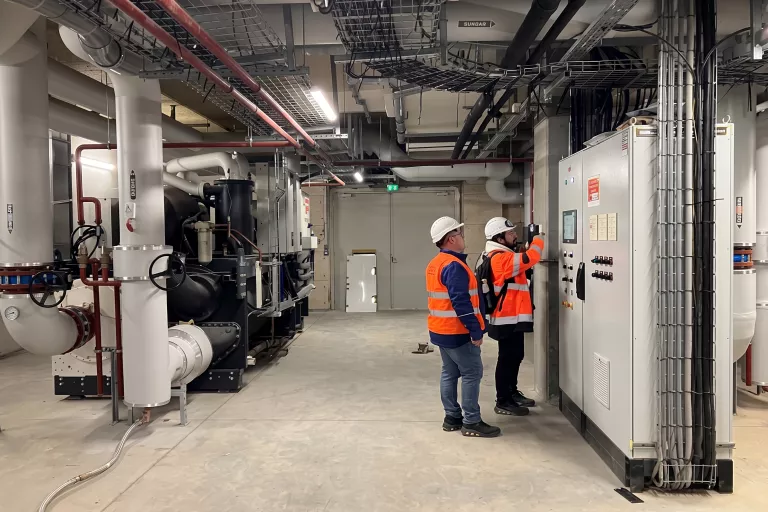
Thanks to an architecture based on more than 1,050 Distech terminal controllers, 103 Schneider AS-P controllers and BACnet IP communication, the systems now benefit from centralised, reliable, and scalable control. The solutions deployed ensure the monitoring and control of several systems critical to the operation of the future hospital.
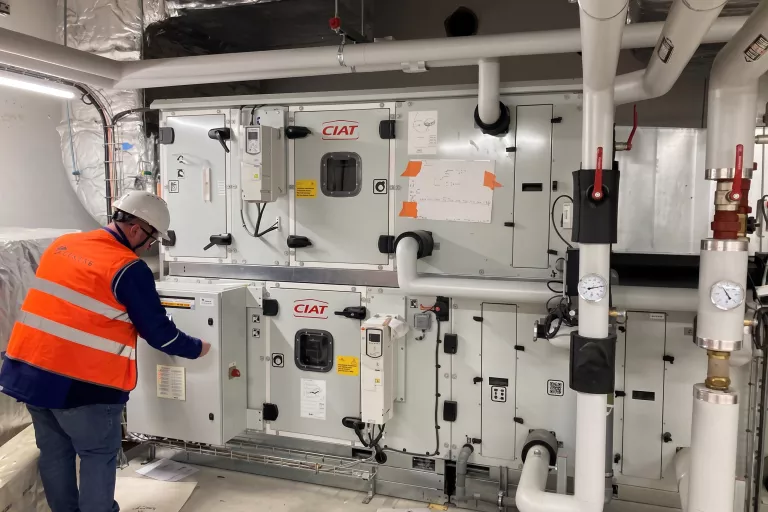
In a hospital setting, air quality is a major health concern. Ventilation and air-handling systems must ensure a constant exchange of air while maintaining the required parameters for each area of the building.
The Equans Digital teams have developed automation systems to control and regulate air-handling equipment, ensuring that environmental conditions meet the requirements of various medical activities.
This continuous monitoring helps maintain occupant comfort, patient safety, and control of health risks.
With more than 110,000 m² of usable space, the new university hospital required an intelligent management system for its heating and air conditioning facilities. The control systems installed allow for continuous adjustment of equipment operation based on the building’s actual needs.
This approach ensures:
- maintenance of setpoint temperatures;
- comfort for patients, visitors, and healthcare staff;
- reducing energy consumption;
- more efficient and sustainable operation of facilities.
Automation thus plays an essential role in balancing comfort, operational performance, and energy efficiency.
In a hospital with nearly 1,400 beds, the continuous operation of the water systems is a fundamental requirement.
The automation systems developed by Equans Digital enable the monitoring and control of equipment related to plumbing systems and potable water networks to ensure their constant availability.
This monitoring helps ensure the safe day-to-day operation of the building and facilitates maintenance operations by technical teams.
Sensitive medical areas are among the most demanding areas in a hospital. The 35 operating rooms and the 26 medical imaging rooms require rigorous control of technical parameters to ensure optimal conditions for medical and surgical procedures.
The automation solutions implemented ensure, in particular:
- maintenance of temperature and humidity conditions;
- control of air-handling systems;
- management of differential pressures;
- the independence of airflow between different zones.
This precise control of the systems directly contributes to the future university hospital’s goals for patient safety and quality of care.
In addition to the medical spaces, the project also included the management of the facility’s data center technical infrastructure.
As the true digital heart of the university hospital, this infrastructure hosts the IT systems essential to hospital operations.
The automation systems developed by Equans Digital ensure that the environmental conditions necessary for the proper functioning of IT equipment are maintained and help safeguard the continuity of digital services.
This project was led by the Equans Digital Building Automation teams in Rouen, who handled all design, development, and commissioning of the systems.
In total, more than 12,000 hours of design, programming, testing, and commissioning were completed over a period of 57 months, supporting every stage of the new hospital’s construction through to its operational launch.
This effort demonstrates Equans Digital’s ability to manage large-scale building automation projects in critical environments where the reliability, safety, and performance of the systems are essential.
FAQ | Building Automation for Hospitals and Healthcare Infrastructure Automation
Building automation enables the control and optimisation of all critical technical systems in a hospital, including heating, ventilation, air conditioning, water systems, and monitoring systems. It ensures the continuity of services while improving energy efficiency and occupant comfort.
A Building Management System (BMS) makes it possible to centralise technical data, automate operating scenarios, detect anomalies in real time, and improve the availability of equipment essential to the hospital’s operations.
Automation systems ensure precise control of airflow, differential pressures, temperature, and humidity. This precise control helps maintain the sanitary conditions required in critical medical environments.
BACnet is an open protocol widely used in complex buildings. It facilitates interoperability between devices and enables simplified integration of technical systems into a centralised monitoring system.
Equans Digital is involved in every stage of the Smart Hospital project: studies, design of automation architectures, development of control strategies, commissioning, facility monitoring, and continuous optimisation of the energy and operational performance of hospital infrastructure.
An Automated Hospital Infrastructure Designed to Enhance Performance and Ensure Continuity of Care

Modernise and automate your critical hospital infrastructure
Equans Digital’s experts support you in the design, integration, and operation of high-performance automation solutions for the most demanding hospitals, clinics, and healthcare facilities. Work with our experts to envision the hospital infrastructure of tomorrow. Contact us today.Modernise and automate your critical hospital infrastructure
Equans Digital’s experts support you in the design, integration, and operation of high-performance automation solutions for the most demanding hospitals, clinics, and healthcare facilities. Work with our experts to envision the hospital infrastructure of tomorrow. Contact us today.